
Canadians are more curious about psilocybin than at any point in the last fifty years. A 2023 Canadian Centre on Substance Use and Addiction report found that psychedelic use among Canadians rose 195% between 2019 and 2023, driven largely by interest in microdosing, therapeutic research, and a broader cultural reappraisal of what cannabis, psilocybin, and related substances actually do to the human mind. If you’ve spent time reading about cannabis and found yourself curious about where psilocybin fits into the picture, you’re part of a much bigger conversation.
This guide is written for Canadian adults who already understand cannabis and want to understand psilocybin — the science, the legal reality, the therapeutic research, the cultural context, and the harm-reduction information that rarely gets covered honestly in one place. We’re a cannabis vape company, not a psilocybin retailer. But our customers ask about magic mushrooms constantly, and the honest answers deserve a proper write-up.
Cannabis and Psilocybin Are Not the Same Thing
The first thing to get straight: cannabis and psilocybin are different substances, with different mechanisms, different effects, different legal statuses, and different use cases. Treating them as interchangeable is a mistake both chemically and practically.
Cannabis primarily acts on the endocannabinoid system through THC binding to CB1 and CB2 receptors. Effects are typically dose-dependent relaxation, altered sensory perception, appetite increase, and mood shift, lasting one to four hours for inhaled products. Cannabis is federally legal in Canada under the Cannabis Act for adults 19+ (18+ in Alberta, 21+ in Quebec). Our full cannabis vape pen collection is what we’ve been shipping coast to coast since 2019.
Psilocybin acts on the serotonin system, primarily through partial agonism at the 5-HT2A receptor. Effects at recreational doses include visual and cognitive changes, altered time perception, emotional intensity, and introspective states, lasting four to six hours. Psilocybin is classified as a Schedule III controlled substance under Canada’s Controlled Drugs and Substances Act (CDSA), meaning possession, production, and sale remain federally illegal outside of Health Canada’s Special Access Program and approved clinical research.
Both substances produce altered states, but they do so through completely different neurological pathways and produce experiences that very few users describe as similar.
The Legal Reality in Canada — No Sugar-Coating
We’re going to be direct because confusion on this point causes real harm. Magic mushrooms are not legal in Canada for general use. The storefronts you may have seen in Vancouver, Toronto, Ottawa, and other Canadian cities operate in a grey market where federal law classifies psilocybin as a controlled substance, but municipal enforcement has largely deprioritized action against small-scale possession and some retail operations.
The facts, as of 2026:
-
- Psilocybin and psilocin remain Schedule III controlled substances under the federal CDSA, applying uniformly across all provinces and territories.
-
- Possession can carry criminal penalties of up to six months for summary conviction or up to three years if prosecuted as an indictable offence. Production or trafficking can carry up to ten years.
-
- No province has formally decriminalized psilocybin. Vancouver’s broader drug-policy conversation and Alberta’s 2023 regulated medical-use framework are distinct from general-use legalization, which has not occurred anywhere in Canada.
-
- Legal medical access exists through Health Canada’s Special Access Program and authorized clinical trials, but pathways are narrow, physician-gated, and typically reserved for treatment-resistant conditions.
-
- Enforcement is highly inconsistent. Online psilocybin dispensaries operate openly, ship across Canada, and collectively serve hundreds of thousands of customers, but operate outside the legal framework.
Anyone considering psilocybin in Canada should understand this clearly: the grey market is not a legal market. It is a tolerated market in most jurisdictions, but tolerance is not legalization, and enforcement can change quickly.
The Therapeutic Research — What the Science Actually Shows
Research interest in psilocybin has accelerated dramatically in the past decade. Johns Hopkins, Imperial College London, NYU, and the University of Toronto have all published peer-reviewed studies on psilocybin’s therapeutic potential. The current evidence base, in broad strokes:
-
- Treatment-resistant depression: Multiple Phase 2 trials have shown significant symptom reduction with one or two supervised sessions, with effects persisting for months in some patients.
-
- End-of-life anxiety: Studies in terminally ill cancer patients have shown durable reductions in death-related distress and depression.
-
- Substance use disorders: Preliminary research on alcohol use disorder and tobacco dependence has shown promise, though larger trials are needed.
-
- PTSD and treatment-resistant anxiety: Active clinical trials are underway in several Canadian and international centres.
Health Canada has approved psilocybin-assisted therapy access for a limited number of patients through the Special Access Program since 2020. The research is genuinely promising — but it’s research, conducted under clinical supervision with trained therapists, standardized dosing, and pre- and post-session integration work. That is a fundamentally different experience than obtaining unregulated product through an online dispensary and self-administering at home.
Microdosing — The Mainstream Curiosity
Microdosing — the practice of taking sub-perceptual doses of psilocybin (typically 50–250 mg of dried mushroom, well below the threshold for any psychedelic effect) on a regular schedule — has become the most visible form of psilocybin use in Canada. Users report improvements in mood, focus, creativity, and emotional regulation, though it’s worth being honest about where the evidence stands.
The research picture on microdosing is mixed. Multiple studies have shown significant self-reported benefits but struggled to demonstrate effects greater than placebo in blinded settings. Other studies have found measurable improvements in specific cognitive and emotional metrics. The honest summary: the subjective experience many users report is real to them, but the scientific consensus on microdosing’s efficacy is not yet settled.
For Canadians researching the topic further, Magic Mushrooms Dispensary is one of the established Canadian online psilocybin sources frequently referenced in microdosing communities, shipping since 2019 with detailed educational content on strains, dosing, and product formats. As with everything in this space: understand the legal context before making any decisions. 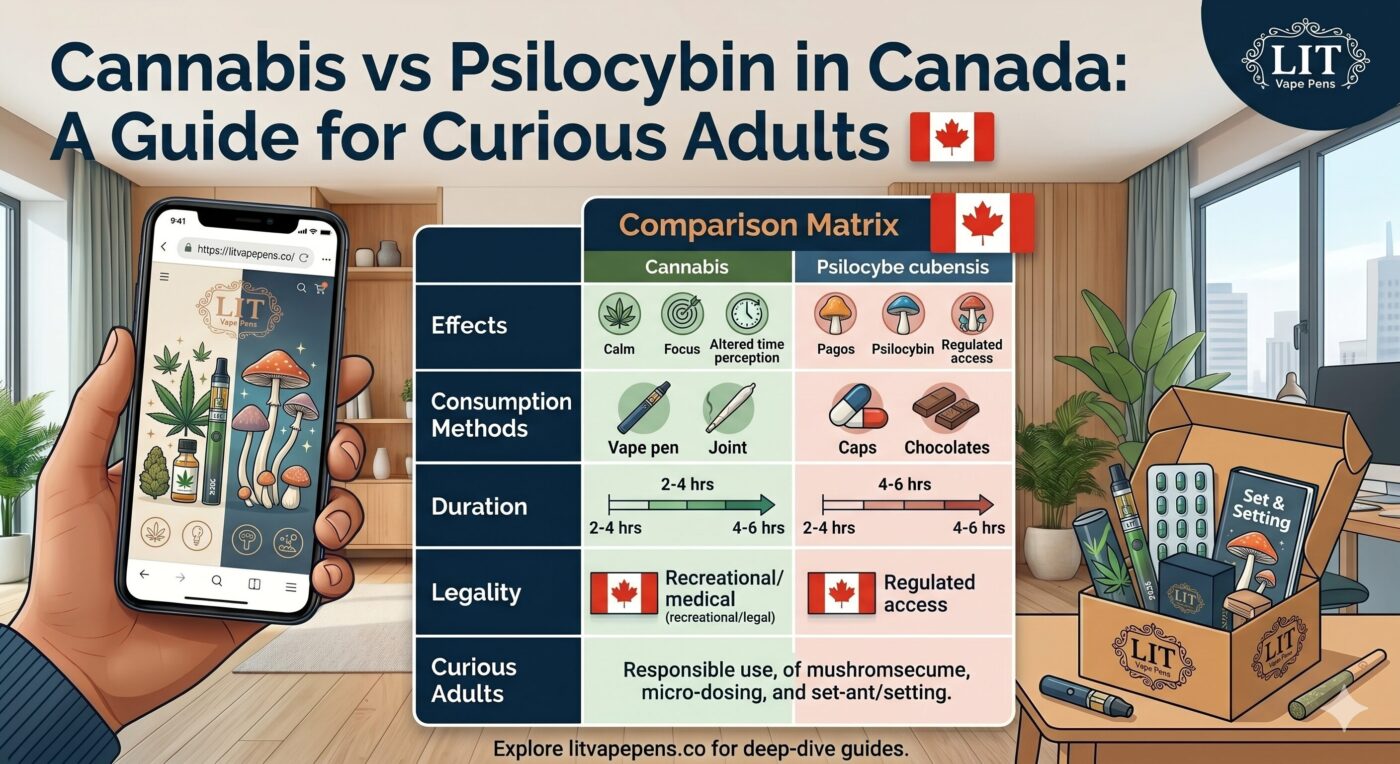
Where Cannabis and Psilocybin Overlap in Use Patterns
The demographic overlap between cannabis users and those curious about psilocybin is significant. Canadian adults who use cannabis — for relaxation, for creativity, for sleep, for mild anxiety management — often express interest in psilocybin for adjacent reasons: mood support, introspection, perspective shifts, or deeper therapeutic exploration. That’s not an accident. Both substances are perceived as more natural, less physically dependency-forming, and more self-directed than pharmaceutical alternatives.
But the use patterns differ meaningfully:
-
- Cannabis is typically used frequently — daily or near-daily use is common and generally well-tolerated at moderate doses for most users.
-
- Full-dose psilocybin is typically used rarely — often once every few months at most, with many users reserving it for specific intentional experiences.
-
- Microdosing sits somewhere in between — regular (often several times weekly) but explicitly sub-perceptual, functioning more like a supplement than a psychedelic experience.
Combining cannabis and psilocybin during the same session is something experienced users sometimes do, but it’s not something we recommend to anyone unfamiliar with both substances separately. Cannabis can significantly amplify and alter the psilocybin experience, sometimes unpredictably. If you’re new to either, know each one independently first.
Harm Reduction — What Actually Matters
If someone is going to use psilocybin regardless of legal status, harm reduction information saves lives and prevents avoidable bad experiences. The essentials every adult should understand:
-
- Mental health history matters. Personal or family history of psychosis, schizophrenia, or bipolar disorder is a serious contraindication. Psilocybin can trigger or worsen psychiatric episodes in vulnerable individuals.
-
- Medication interactions are real. SSRIs, SNRIs, MAOIs, lithium, and tramadol all have documented interactions with psilocybin ranging from reduced effects to dangerous serotonin syndrome.
-
- Set and setting matter more than most people realize. Emotional state going in, physical environment, and the people around you shape the experience more than dose does within typical ranges.
-
- Start low, especially the first time. Tolerance, metabolism, and individual sensitivity vary enormously. The dose that works for a friend may not be your dose.
-
- Have a sober, trusted person available. Especially for first experiences. Someone grounded who can help if the experience becomes difficult.
-
- Product identity and dosing accuracy matter. Unregulated product can vary significantly in potency. Labelled dosing on edibles and capsules is more reliable than unlabelled dried material.
-
- Never inject psilocybin. Health Canada has explicitly warned about cases of severe infection, septic shock, and death from IV administration.
Canadian harm reduction organizations including the Canadian Students for Sensible Drug Policy and TRIP! Project (Toronto) publish detailed safer-use resources worth reading before any psychedelic experience.
What to Expect From a Psilocybin Experience
For readers familiar with cannabis but curious about psilocybin, the experiential differences are significant. Cannabis at moderate doses produces a relatively predictable, dose-responsive effect most users can navigate comfortably. A full psilocybin dose is a qualitatively different experience — longer, less predictable, more emotionally and perceptually intense, and considerably harder to abort mid-experience.
Onset is typically 20–45 minutes after ingestion. The experience peaks around 1.5–3 hours in and gradually subsides over the following 2–3 hours, with some residual effects sometimes lasting into the next day. Visual changes can range from mild colour enhancement at lower doses to significant perceptual distortion at higher ones. Emotional intensity is common. Time perception is consistently altered. Memory of the experience is usually clear, often sharper than cannabis experiences.
This is not better or worse than cannabis. It is different, and respecting the difference is what separates users who find psilocybin meaningful from those who find it overwhelming.
The Bigger Picture for Curious Canadians
Psilocybin is having a cultural moment in Canada that mirrors in some ways where cannabis sat ten to fifteen years ago — a substance with growing therapeutic evidence, growing public interest, and an informal market operating ahead of regulation. Whether that trajectory leads to cannabis-style legalization, a more restricted medical framework like Alberta’s, or something else entirely is genuinely unclear. The legal reality in 2026 is that psilocybin remains federally controlled, enforcement is inconsistent, and anyone making choices in this space needs to make them with clear information rather than wishful thinking.
For cannabis users who want to stay in the legal, regulated space, that remains what we offer — our THC and CBD vape pens are CO2-extracted, lab-tested every batch, and federally legal for Canadian adults. For those who want to read further on the psilocybin side, the research databases (PubMed, Google Scholar), harm reduction organizations, and established Canadian educational resources are the place to start. Wherever your curiosity takes you: go in informed.
Frequently Asked Questions
Are magic mushrooms legal in Canada in 2026?
No. Psilocybin and psilocin remain Schedule III controlled substances under the Controlled Drugs and Substances Act. Limited legal access exists through Health Canada’s Special Access Program and approved clinical trials. No province has formally decriminalized psilocybin. Storefronts and online dispensaries operating in Canadian cities do so in a grey market where municipal enforcement has been inconsistent, but the underlying federal law has not changed.
Is microdosing psilocybin legal in Canada?
No. Possession of psilocybin in any amount, including microdose quantities, is technically illegal under the CDSA, though enforcement for small personal-use quantities is often deprioritized. Microdosing is not legally distinguished from any other unauthorized psilocybin possession in Canadian federal law.
How do cannabis and psilocybin effects compare?
They are substantially different substances acting on different neurological systems. Cannabis primarily affects the endocannabinoid system and produces typically one-to-four-hour effects that most users find manageable. Psilocybin acts on serotonin receptors and produces four-to-six-hour experiences that are longer, more perceptually intense, and less easily aborted. Both are used by overlapping demographics but serve different use cases.
What are the main risks of psilocybin?
Personal or family history of psychosis, schizophrenia, or bipolar disorder is a serious contraindication. Psilocybin also interacts with SSRIs, SNRIs, MAOIs, lithium, and several other medications. Psychological difficulty during the experience is possible and is best navigated with a trusted sober person present. Unregulated product quality and dosing accuracy can vary. Never inject psilocybin — Health Canada has documented serious harm including death from IV administration.
Can I combine cannabis and psilocybin?
Experienced users sometimes combine the two, but we don’t recommend it for anyone unfamiliar with each substance independently. Cannabis can significantly amplify and alter psilocybin effects, sometimes unpredictably. Understand each one separately before considering combinations.
This article is for informational purposes only. It is not medical advice, not legal advice, and not an endorsement of any substance use. Cannabis products sold by LiT Vape Pens are federally legal for Canadian adults 19+ (18+ AB, 21+ QC). Psilocybin remains a controlled substance under the Controlled Drugs and Substances Act in Canada. For legal psilocybin access, speak to a licensed healthcare practitioner about Health Canada’s Special Access Program.
Related LiT guides.
Turn the guide into a confident choice.
Compare LiT cartridges, reusable kits and disposable pens, or contact the team if compatibility is still unclear.